
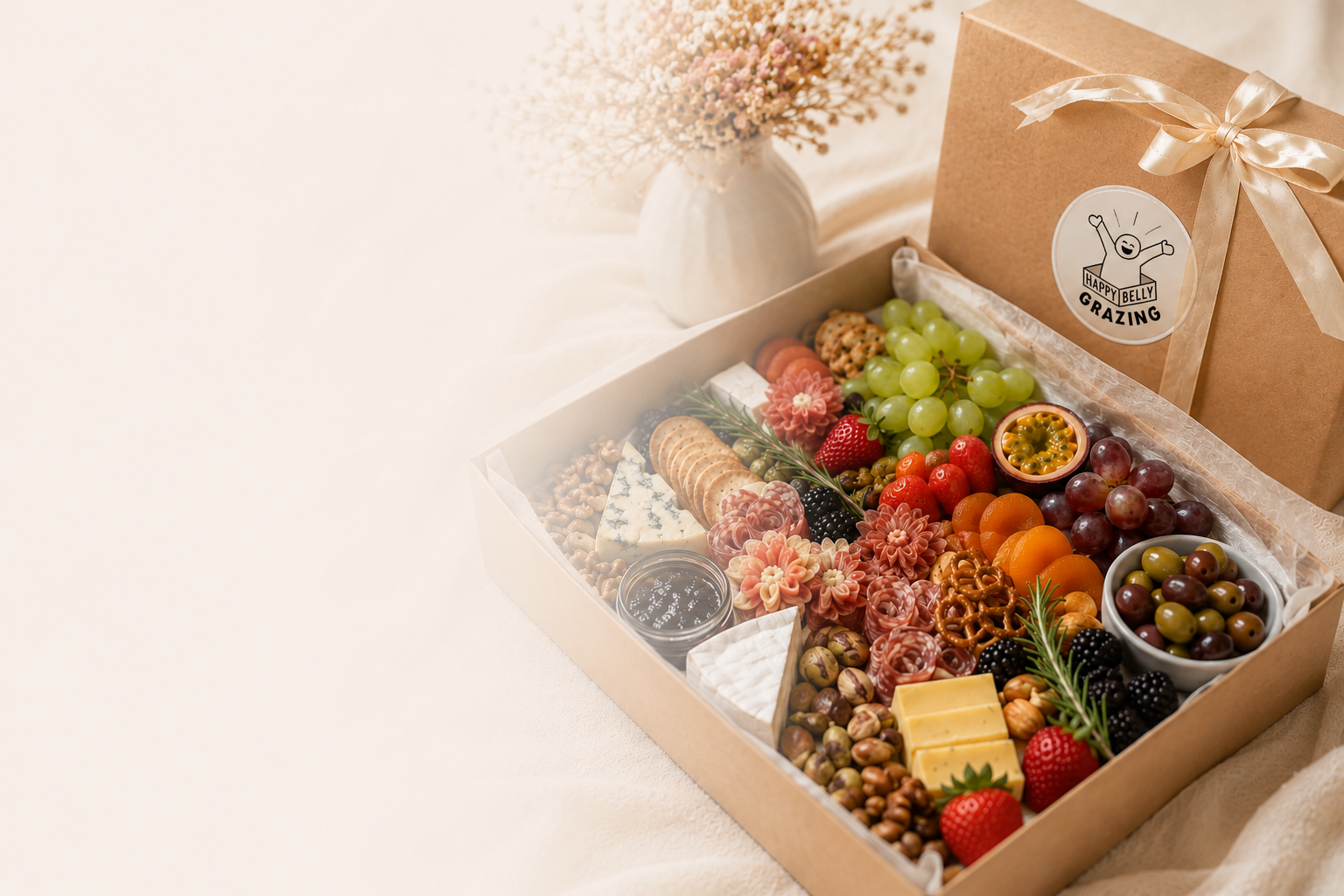

Frequently Asked
Questions
Find answers to our most common questions about grazing tables, grazing boxes, dietary requirements, ordering and delivery..

Everything You
Need to Know
We've gathered the answers to our most frequently asked questions to help make planning your order as simple as possible. Browse the topics below and if you still need assistance, we'd love to hear from you.


Frequently Asked
Questions
Find the information you're looking for by expanding the topics below.


Low FODMAP
Learn more about the Low FODMAP diet, common ingredients and how Happy Belly Grazing creates delicious grazing experiences while considering dietary needs.
-
FODMAPs is an acronym which stands for specific types of sugars that are found naturally in various foods - dairy and alternatives, fruit, vegetables, legumes, nuts and grains. FODMAPs are not completely digested and absorbed in our intestines, and for people with Irritable Bowel Syndrome (IBS) this can trigger symptoms including pain, bloating, excess gas, diarrhoea and/or constipation. FODMAP intolerance can vary from person to person, in the type(s) of FODMAP and quantity in which it is problematic.
F - Fermentable
O - Oligosaccharides
D - Disaccharides
M - Monosaccharides
A - And
P - PolyolsFor further information, please visit https://www.monashfodmap.com/about-fodmap-and-ibs/
-
The low FODMAP diet has been shown to improve symptoms in up to 75% of people with IBS. It is not designed to be a long-term restrictive diet, but is more of a multi-phase process which consists of:
Phase 1 - Follow a low FODMAP diet for 2-6 weeks to achieve symptom reduction.
Phase 2 - Begin staged and structured ‘challenges’ to determine which FODMAPs are problematic for you, and in what quantities.
Phase 3 - Using the information gained from Stage 2, a long-term plan is developed to establish symptom control using as little restriction as possible.
It is strongly recommended that the low FODMAP diet be completed with the support of an Accredited Practising Dietitian, and that before commencing you see a medical doctor to rule out other conditions.
-
Lactose is a disaccharide, and is the ‘D’ in the FODMAP acronym. The low FODMAP diet is not a dairy-free diet. Low FODMAP dairy products include various cheeses, butter, cream, and lactose-free milk/yoghurt.
The cheeses we have selected for your grazing box are low FODMAP because they have been aged - such as brie, blue, and hard cheeses including cheddar. Due to the manufacturing process, these cheeses only contain very small amounts of lactose - typically less than 0.5g lactose per 100g of cheese.
Many people who are lactose-intolerant can handle approximately 12g lactose, or ~1 cup of milk in one sitting, and potentially even more lactose if spread across the day.
-
Not necessarily - most salami manufacturers add in garlic, an oligosaccharide which forms the ‘O’ in the FODMAP acronym. This may be stated clearly in the ingredients list, or listed as ‘vegetable extract’ or ‘dehydrated vegetables’.
-
We have carefully selected the ingredients and control the amounts provided to ensure that there is still an overall low FODMAP ‘load’. The low FODMAP diet does not avoid every trace of FODMAPs - it is the ‘low’ not the ‘no’ FODMAP diet!
-
There are many reasons as to why you may still be experiencing gut symptoms. These reasons could be related to your diet, dietary patterns, lifestyle, or could be medical. If you are seeking further assistance, do not hesitate to book an appointment with an Accredited Practising Dietitian.
-
Gluten is a type of protein which is found in wheat, rye, barley, and triticale. FODMAPs are types of sugars which are also found in these same foods. Therefore many food products which are labelled ‘gluten free’ are often low FODMAP as well, because these foods are excluded.
Individuals with IBS report an improvement in symptoms when switching to a gluten free diet, however this is most likely due to consuming less FODMAPs.
It is worth noting that not all foods which are gluten free are low FODMAP (Eg: onions), and not all foods which are low FODMAP are gluten free (Eg: sourdough bread)!
In people with coeliac disease, gluten must be avoided as it causes damage to the small intestine when consumed. While oats are technically ‘gluten free’, they are not currently recommended for people with coeliac disease due to the presence of a ‘gluten like’ protein.
Happy Belly Grazing
Learn more about Happy Belly Grazing, our products and what makes our grazing experiences unique.
-
Happy Belly Grazing was developed by an Accredited Practising Dietitian who has completed further training in the low FODMAP diet for IBS, and regularly assists clients in managing IBS in clinical practice.
We curate only the best low FODMAP ingredients, while carefully considering the total FODMAP ‘load’ in your grazing boxes. Our ultimate goal is help you enjoy good food, good company, and to take the guesswork out of your food choices.
We use low FODMAP fruits, vegetables, crackers, deli meats, cheeses and sweet treats.
-
All ingredients used in Happy Belly Grazing products are gluten free. However, because our grazing boxes/tables are not prepared in a gluten free facility, they may contain traces of gluten. If you have coeliac disease and wish to proceed with your order, we will ensure that extra precautions are taken to prevent cross contamination.
-
Gluten is a type of protein which is found in wheat, rye, barley, and triticale. FODMAPs are types of sugars which are also found in these same foods. Therefore many food products which are labelled ‘gluten free’ are often low FODMAP as well, because these foods are excluded.
Individuals with IBS report an improvement in symptoms when switching to a gluten free diet, however this is most likely due to consuming less FODMAPs.
It is worth noting that not all foods which are gluten free are low FODMAP (Eg: onions), and not all foods which are low FODMAP are gluten free (Eg: sourdough bread)!
In people with coeliac disease, gluten must be avoided as it causes damage to the small intestine when consumed. While oats are technically ‘gluten free’, they are not currently recommended for people with coeliac disease due to the presence of a ‘gluten like’ protein.

We're Here to Help
Can't find the answer you're looking for? We'd love to help with any questions about our grazing tables, grazing boxes or dietary requirements.